Delegation That Works: How to Assign Tasks Without Losing Ownership

Fluorine

Startups move quickly, but growth can stall when founders try to do everything themselves. As teams expand and priorities shift, the ability to delegate — and do it well — becomes a true superpower. In fact, a Gallup study of Inc. 500 CEOs found that those with high delegation talent saw a three-year growth rate 112 percentage points higher than their peers, and generated 33% more revenue in 2013 (news.gallup.com).
This isn’t just theory: effective delegation strategies are a proven driver of productivity and sustainable business growth. If your startup still relies on scattered tools and unclear responsibilities, it’s time to rethink how you assign work.
TL;DR / Key takeaways:
Delegation breaks when ownership, deadlines, and “done” criteria aren’t clear.
Assign one owner per task to avoid confusion and dropped work.
Use a simple checklist for context, deadline, and success criteria.
Track progress with visible statuses and lightweight updates—not constant pings.
Treat multi-step work as a project, and one deliverable as a one-off task.
Many startup teams delegate faster when tasks, discussions, and decisions live in one place, such as an all-in-one workspace like Fluorine built for startups and growing teams.
Why Delegation Breaks in Startup Teams
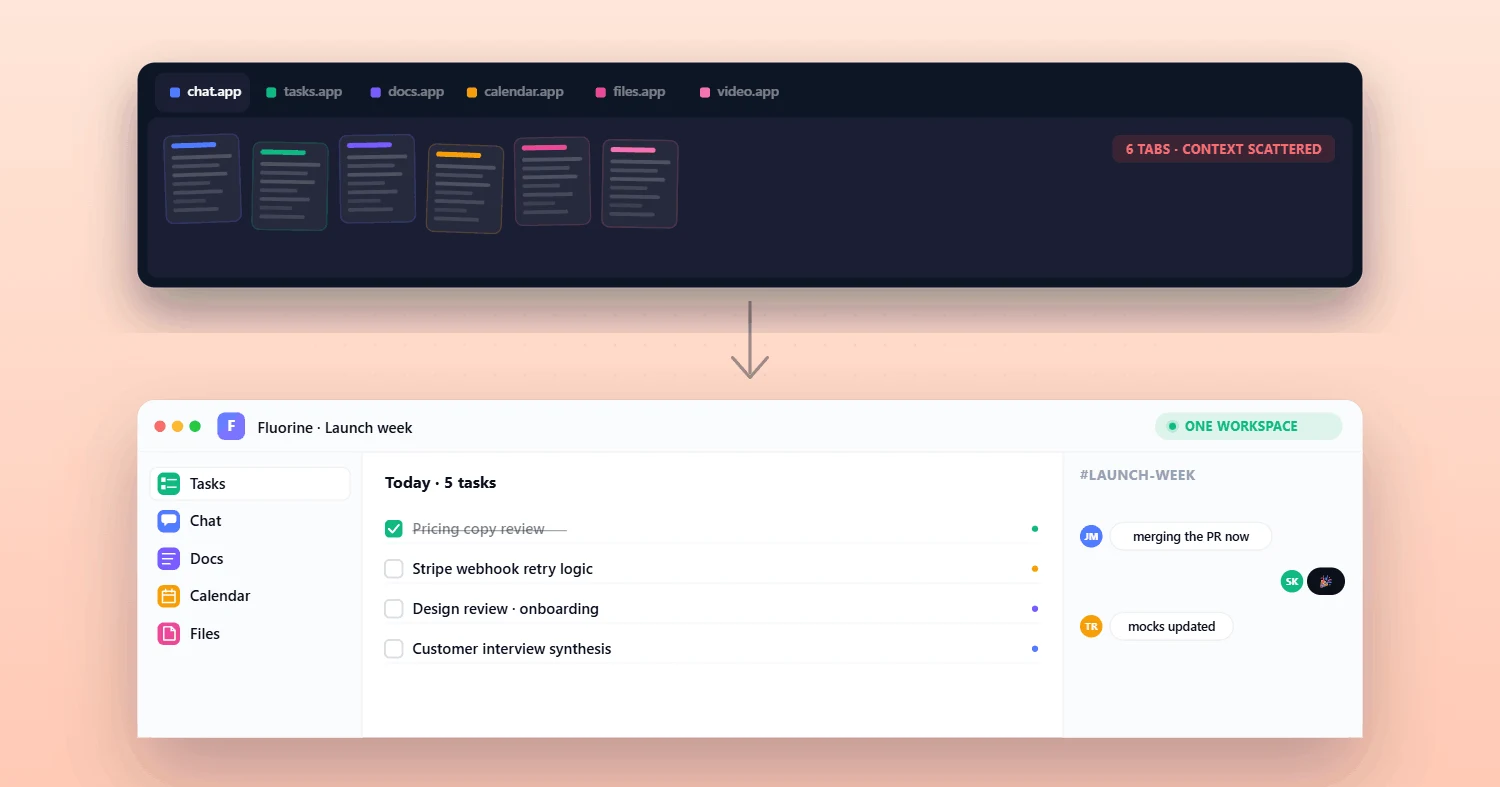
Startups often struggle with delegation in startups because work is spread across Slack, email, and separate task tools, making ownership and deadlines fuzzy. Only one in four entrepreneurs naturally possesses high delegation talent, meaning 75% of founders risk hitting avoidable growth ceilings due to poor delegation (news.gallup.com). An all-in-one workspace like Fluorine can help reduce that ambiguity by keeping tasks and communication in the same place.
Simply put, when tasks like “handle onboarding” lack deadlines or done criteria, teams waste energy and lose focus.
This leads to missed opportunities and operational bottlenecks that slow down momentum. Frequent shifts in priorities and unclear task assignments can cause confusion, leading to duplicated effort or work that falls through the cracks.
This is compounded by disconnected feedback and surveys, which further fragment team alignment and can increase the risk of missing critical deadlines.
Ownership vs Participation: What “Assigned” Really Means
It’s a question nearly every startup faces: what’s the difference between owning a task and just participating in it? The real answer is that true task ownership means one person is directly accountable for seeing the work through to completion. When a task is assigned to multiple people, it often leads to confusion—everyone assumes someone else will lead, and in the end, no one does.
As Byron Dorgan aptly put it, “You can delegate authority, but you cannot delegate responsibility.” (leadersedge360.com)
Clear accountability also boosts employee engagement, as team members who own their work are more likely to feel invested in outcomes and motivated to exceed expectations.
What really matters is clarity: one owner per task, always. This keeps team accountability strong and prevents the diffusion of responsibility. In tools like Fluorine, clear task ownership means nothing falls through the cracks and everyone knows exactly what’s expected.
The Delegation Checklist: Context, Deadline, Done
The Assignment Checklist
Delegation is most effective when it follows a systematic approach. Here’s a step-by-step checklist that startup teams can use to delegate with confidence:
Provide context: Explain why the task matters and how it fits into the bigger picture.
Define the outcome: Set clear “done” criteria so everyone knows what success looks like.
Assign one owner: Avoid shared ownership—make sure there’s a single accountable person.
Set a deadline: Specify when the task should be completed.
Clarify dependencies: Note any preceding work or required resources.
Document everything: Use a shared workspace or tool to track progress and keep everyone aligned.
A study in the International Journal of Entrepreneurship found that using frameworks like RACI improves task assignment clarity and employee engagement, accelerating business growth (abacademies.org). Startups with structured delegation frameworks scale 2.5 times faster than those without (ainvest.com).
Quick Examples for Common Startup Tasks:
“Publish next week’s blog post” — Owner: Sarah; Deadline: Friday; Done criteria: Edited and uploaded to CMS.
“Prepare onboarding for new hire” — Owner: Alex; Deadline: Wednesday; Done criteria: All documents sent, workspace access granted.
If the assignee can’t describe “done,” rewrite the task for clarity. For more on this, see our guide to writing clear task descriptions.
Remember, providing complete context and linking supporting resources or documentation can accelerate task onboarding for new team members.
A Simple Delegation Workflow for Remote and Hybrid Teams
Delegation gets harder when your team isn’t in the same room. In remote and hybrid environments, the goal is to make your startup delegation process easy to follow without relying on constant meetings or DMs.
Write the handoff down: Put the context, deadline, and “done” criteria in the task itself so people aren’t searching through chats.
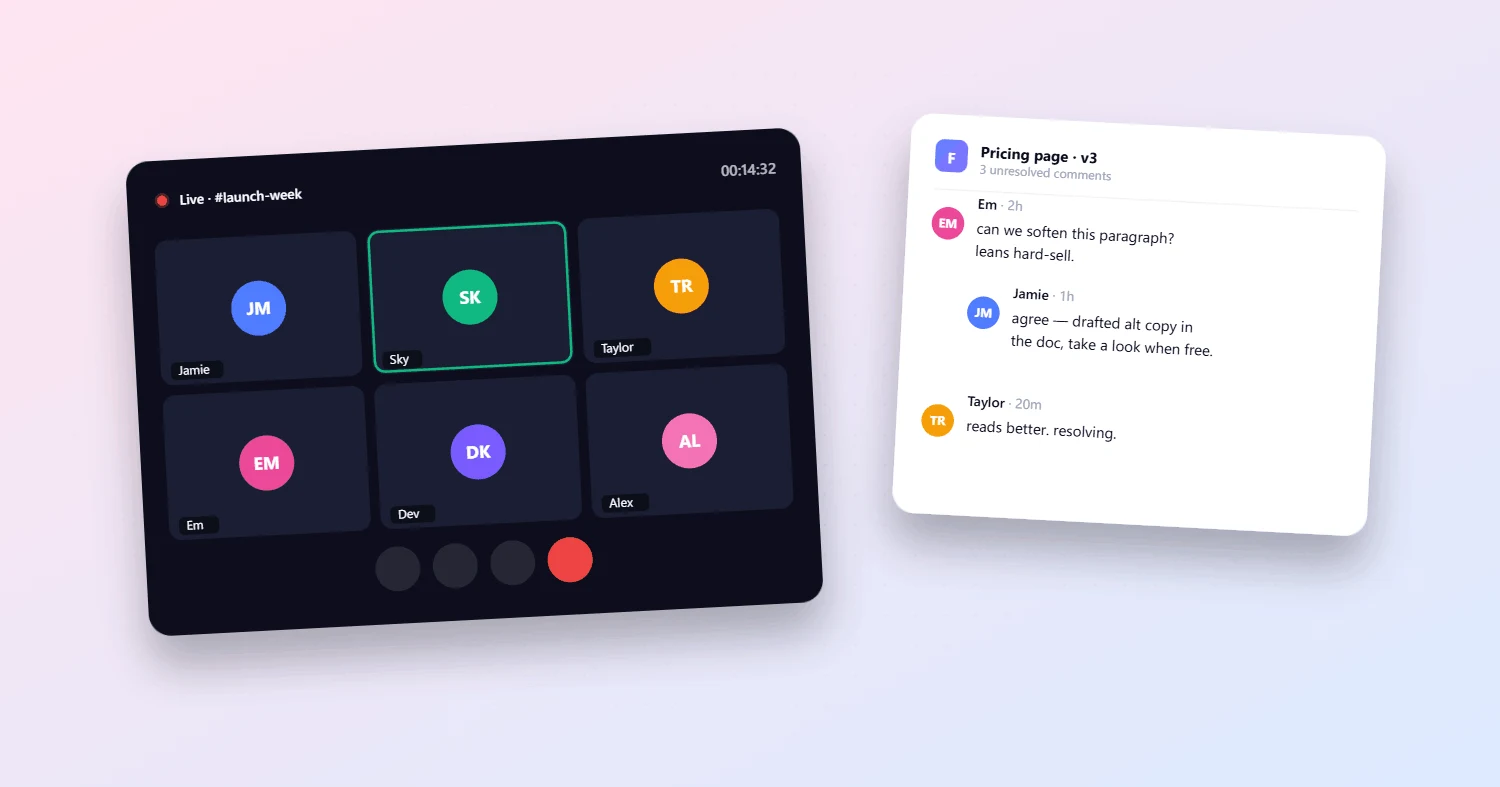
Default to async updates: Use comments for progress notes and questions so decisions stay attached to the work.
Make blockers visible: If something is “blocked,” add what’s missing (approval, asset, decision) so leaders can unblock quickly.
Close the loop: When work is “done,” capture the outcome (link, doc, shipped feature) so stakeholders don’t have to ask.
Tracking Progress Without Hovering
Ever feel the urge to ping your team for updates, just to make sure nothing’s falling behind? That’s a warning sign that your delegation system needs more visibility. The best founders monitor execution through transparent status updates, not by hovering over every move.
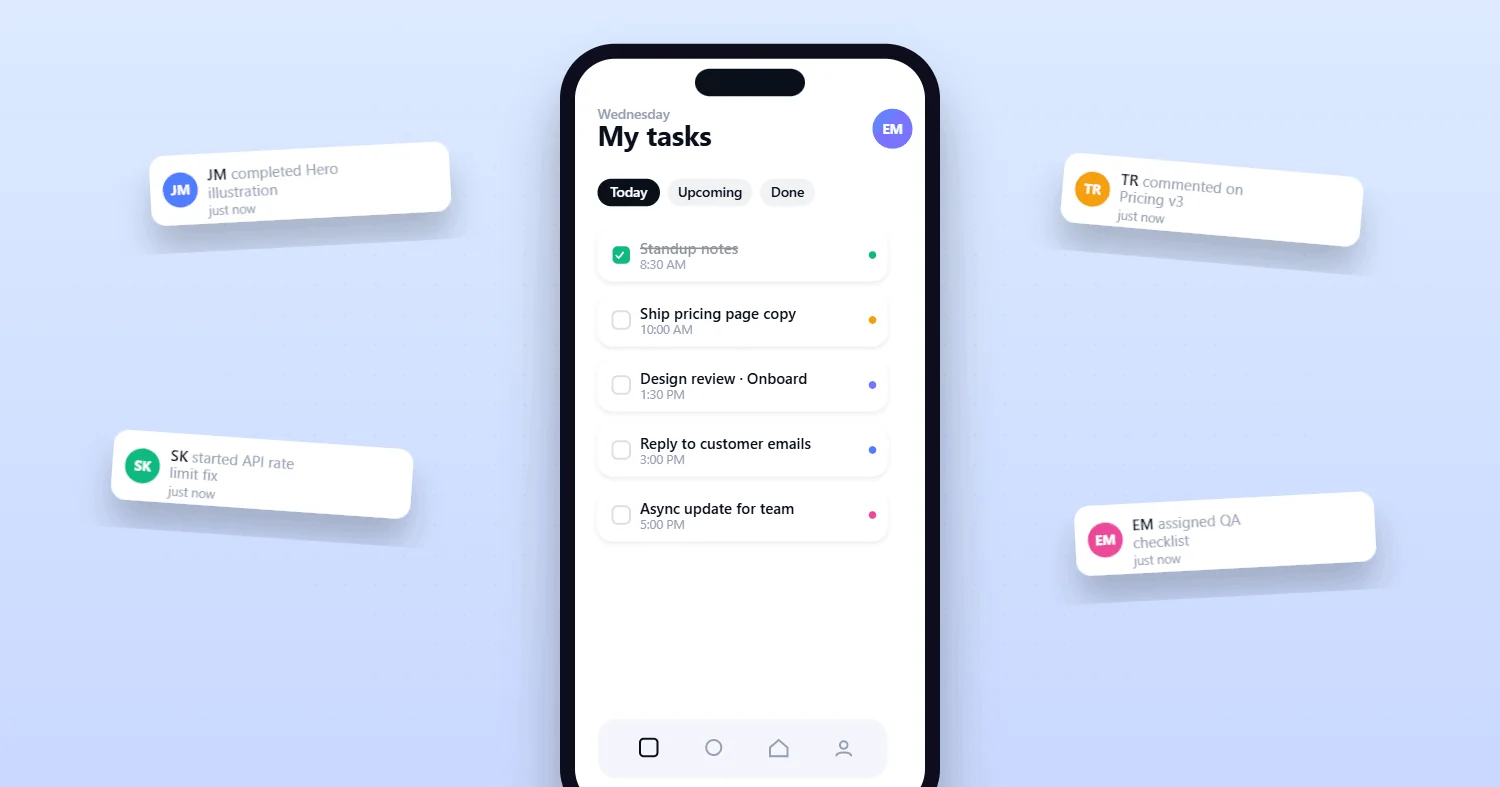
Status systems: Use task statuses (“in progress,” “blocked,” “done”) so everyone can see where work stands.
Short updates: Encourage brief weekly check-ins via comments or chat, not meetings.
Scan for blocks: Leaders should review the task board for any items stalled or missing context, then ask what’s needed to get things moving.
Review rhythm: Set a weekly planning review to scan what’s on track and what needs attention.
With the right SaaS tools, managers gain visibility into progress across the team, reducing the need for disruptive check-ins and enabling quick identification of blocked work.
According to DUQE, strategic delegation supported by tools like Asana and ClickUp can deliver productivity gains of up to 33% (duqe.ae).
For more on status workflows, see task status systems that work.
Delegation Inside Projects vs One-Off Tasks
When should you treat work as a project, and when is a single task enough? Projects involve multiple dependencies and often require coordination across several people; a one-off task is a simple, standalone deliverable.
One-Off TaskProjectDefinitionSingular, standalone assignmentGroup of related tasks with milestonesOwnershipOne personProject manager or team leadDependenciesUsually noneMultiple, often cross-functionalTrackingSimple checklistTimeline, status, and documentationVisibilityOwner and assignerAll stakeholders
Projects benefit from frameworks like RACI to clarify roles, prevent overlap, and keep accountability strong as teams grow.
A recent case study in the International Journal of Entrepreneurship found that startups with clear project and task assignments see increased employee commitment and internal competitiveness, driving business growth (abacademies.org).
For a deeper dive, see our guide to choosing the right management approach.
Closing: Delegation Is a System, Not a Handoff
Too often, teams see delegation as a one-time handoff. In reality, it’s a system—a repeatable process for assigning, tracking, and closing out work. Startups leveraging integrated delegation tools can scale 35% faster than those relying on traditional methods (ainvest.com).
Delegation works when tasks are clear and progress is visible.
Try Fluorine to delegate your next project in a single workspace and see how much further your team can go.
By consolidating communication, tracking, and feedback in one platform, teams can reduce tool sprawl and eliminate the headaches of switching between disconnected apps.
Frequently Asked Questions
What’s the biggest reason delegation fails in startups?
It usually comes down to missing clarity: no single owner, no deadline, and no shared definition of “done.” When work lives across multiple tools, it’s also easy for key details to get buried and for tasks to lose momentum.
Should a task ever have more than one owner?
Not if you want clear accountability. People can contribute, but a task is easier to move forward when one person is responsible for closing it out. That’s the core of team accountability—everyone knows who’s driving the work to completion.
What should I include when I assign work?
At minimum: context (why it matters), a deadline, and “done” criteria. The article’s delegation checklist also calls out dependencies and documentation, which helps reduce back-and-forth and makes the handoff easier to execute.
How do I track delegated work without micromanaging?
Use visible statuses (in progress, blocked, done) and lightweight written updates. When blockers show up clearly, leaders can step in to remove obstacles rather than chasing people for progress reports.
References
Gallup. (2014). Delegating: A Huge Management Challenge for Entrepreneurs. https://news.gallup.com/businessjournal/182414/delegating-huge-management-challenge-entrepreneurs.aspx
International Journal of Entrepreneurship. (2023). Delegation and collaboration practices embrace innovative ideas for business growth in small to medium enterprises. https://www.abacademies.org/articles/Delegation-and-collaboration-practices-embrace-innovative-ideas-for-business-growth-in-small-to-medium-enterprises-1939-4675-24-1-355.pdf
AInvest. (2023). Capitalizing founder time allocation: Secret sauce for scalable investment returns. https://www.ainvest.com/news/capitalizing-founder-time-allocation-secret-sauce-scalable-investment-returns-2509/
DUQE. (2023). Empowering your startup team through strategic delegation. https://www.duqe.ae/empowering-your-startup-team-through-strategic-delegation/
leadersedge360.com. (2023). Delegation Quotes. https://leadersedge360.com/quotes/Delegation%20Quotes.pdf
Related topics
You may also like
Discover more articles that expand on similar ideas and themes

Stop switching tabs. Start actually shipping.
Fluorine replaces the stack your team already pays for. Add AI that does the work no one has time for. Start your free trial today.