January 18, 2026

Copied

Team Communication Best Practices For Distributed And Hybrid Teams

Team Collaboration

As distributed team communication and hybrid team communication become standard practice, organizations must rethink how they keep teams aligned and productive. Recent studies show that as of 2025, about 45% of remote-capable employees worldwide—and 53% in the U.S.—work in hybrid arrangements, highlighting the widespread adoption of these models (prodshell.com; news.amply.co). With hybrid work, productivity isn’t just maintained—it often improves. According to a global study, businesses adopting hybrid models saw an 11% productivity boost, and 90% of employees reported being as productive or more productive than in traditional setups (work.iwgplc.com; zoom.com).

For startups and growing teams, building the right communication system is now a strategic imperative. That’s where an all in one task management and communication platform can make all the difference.

The 3 Communication Failures That Kill Alignment

Communication breakdowns remain the leading cause of misalignment in distributed and hybrid teams. Studies reveal that 50% of IT projects fail due to poor communication, often caused by unclear goals, inconsistent feedback, and misaligned expectations—costing organizations billions (globenewswire.com).

Beyond lost productivity, persistent communication breakdowns can erode trust and weaken team morale, making it harder to sustain high performance.

Here’s how these breakdowns most often surface:

  • Too Much Chat, Not Enough Clarity
  • Decisions Are Not Documented
  • No Stable Place to Find “What’s Happening”

When teams lack a core task and collaboration features hub, scattered information and missed updates are almost inevitable.

Solving these issues is the first step toward sustainable team alignment.

Too Much Chat, Not Enough Clarity

Endless streams of chat messages can create more noise than clarity. Team members may spend hours sifting through conversations for crucial information, leading to confusion and wasted time.

Without structure, chat fatigue sets in quickly, making it harder to focus on what truly matters.

For distributed teams, relying solely on team chat applications often results in missed updates and duplicate efforts. Focusing on clarity—not just activity—is key to effective communication.

Embracing asynchronous communication tools can help teams cut through the noise and allow members to respond thoughtfully rather than reactively.

Decisions Are Not Documented

It’s a question nearly every remote or hybrid team faces: Why does failure to document decisions consistently create confusion?

The real answer is that without proper documentation, important choices and rationales get lost, leading to repeated discussions or avoidable errors. Industry consensus is clear: effective documentation acts as a single source of truth, reducing errors and miscommunication for distributed teams.

For example, Tata Consultancy Services maintained high employee engagement by pairing structured communication protocols with regular documentation in their distributed workforce.

For deeper guidance, consult Fluorine documentation, which streamlines how teams record and retrieve decisions for lasting clarity.

No Stable Place to Find “What’s Happening”

Teams need a reliable way to track progress and updates. Without a centralized workspace, important information can easily slip through the cracks.

Visibility is the foundation of team alignment and execution.

A centralized workspace for tasks and communication keeps everyone informed, minimizing the risk of missed deadlines or duplicated work.

Leading distributed teams like Slack have shown that creating a digital-first culture with unified platforms is key to sustaining visibility and community.

Principles That Work Across Teams

Universal principles can help distributed and hybrid teams thrive, regardless of their size or industry. Notably, a study in Nature found that after managers adopted clear communication guidelines, their view of hybrid work’s impact on productivity shifted from negative to positive (zoom.com).

Here’s how to build a solid communication foundation:

  • Default to Written, Searchable Communication
  • Separate Status Updates from Discussions
  • Keep Communication Attached to Work Items When Possible

Regularly reviewing and refining communication agreements ensures these principles remain effective as teams evolve.

Leveraging advanced features like customizable workflows can help teams put these principles into practice.

Default to Written, Searchable Communication

Making communication written and searchable—using tools like Slack or Rocket.Chat—ensures transparency and provides a permanent record for everyone, regardless of location.

Written communication saves time and reduces misunderstandings for distributed teams.

With features like smart search in an all in one task management and communication platform, teams can quickly access the information they need—without digging through endless chat logs.

Separate Status Updates from Discussions

It’s tempting to blend quick updates with deeper discussions, but this blurring leads to confusion and missed action items.

Teams that clearly distinguish between status updates and discussions—using dedicated channels or threads—report fewer misunderstandings. As experts recommend, clarifying the purpose of each channel or thread helps prevent confusion and ensures information flows efficiently.

For more on structuring your workflow, visit support and resources.

Keep Communication Attached to Work Items When Possible

Attaching conversations directly to tasks or projects keeps communication in context.

Context-rich communication reduces the need to switch between platforms and helps teams stay focused.

For example, integrating comments and feedback with tasks using core task and collaboration features ensures nothing important gets lost.

When communication is tied to both tasks and analytics, teams can continuously improve as they collaborate.

A Simple Communication Structure

A step-by-step approach to structuring team communication can improve clarity and execution. A global study found distributed teams spent nearly 16 hours per week in meetings—adopting a structured framework helps teams use that time more effectively (arxiv.org).

Here’s how to build one:

  1. Channels/Spaces by Team and Project: Organize communication by relevant teams or projects, reducing noise and improving focus. This structure helps teams reduce irrelevant chatter and ensures important updates reach the right people, as demonstrated by tools like Flock and Rocket.Chat.

For setup tips, see manage your team in Fluorine.

  1. Threads for Decisions: Use threads to capture decisions and keep related discussions together, making it easier to track context. Threads make it easier to maintain context over time, so key decisions don’t get buried or forgotten.

Advanced threading options are available in power user workflows.

  1. Weekly Written Updates: Require regular written updates to keep everyone aligned. Teams that commit to this practice see improved engagement, as regular check-ins have been shown to boost team morale and accountability.

For templates and best practices, visit the help center.

If you want communication and execution in one place, explore Fluorine’s docs.

Regular review and adaptation of these structures help teams stay efficient as projects and team compositions change.

How to Reduce Meetings Without Losing Connection

Many distributed teams struggle with meeting overload. Research shows distributed projects average nearly 16 hours per week in scheduled and unscheduled meetings—adopting asynchronous practices can reduce this burden (arxiv.org).

Comparison:

Traditional MeetingsAsynchronous Status UpdatesTime CommitmentHigh: multiple hours per weekLow: flexible, on your scheduleEngagementVariable; can cause fatigueHigher when check-ins are regularFocusEasily lost in long callsMaintained through concise updatesProductivityCan disrupt deep workEnables more focused workflow

Teams that shift to async updates report fewer meetings without sacrificing engagement or clarity. This shift is supported by recent research on async practices.

Industry leaders like Cognizant emphasize that reducing unnecessary synchronous meetings can enhance work-life balance and focus, allowing distributed teams to do their best work.

For more on optimizing your team’s workflow, see the centralized workspace for tasks and communication.

Async Status

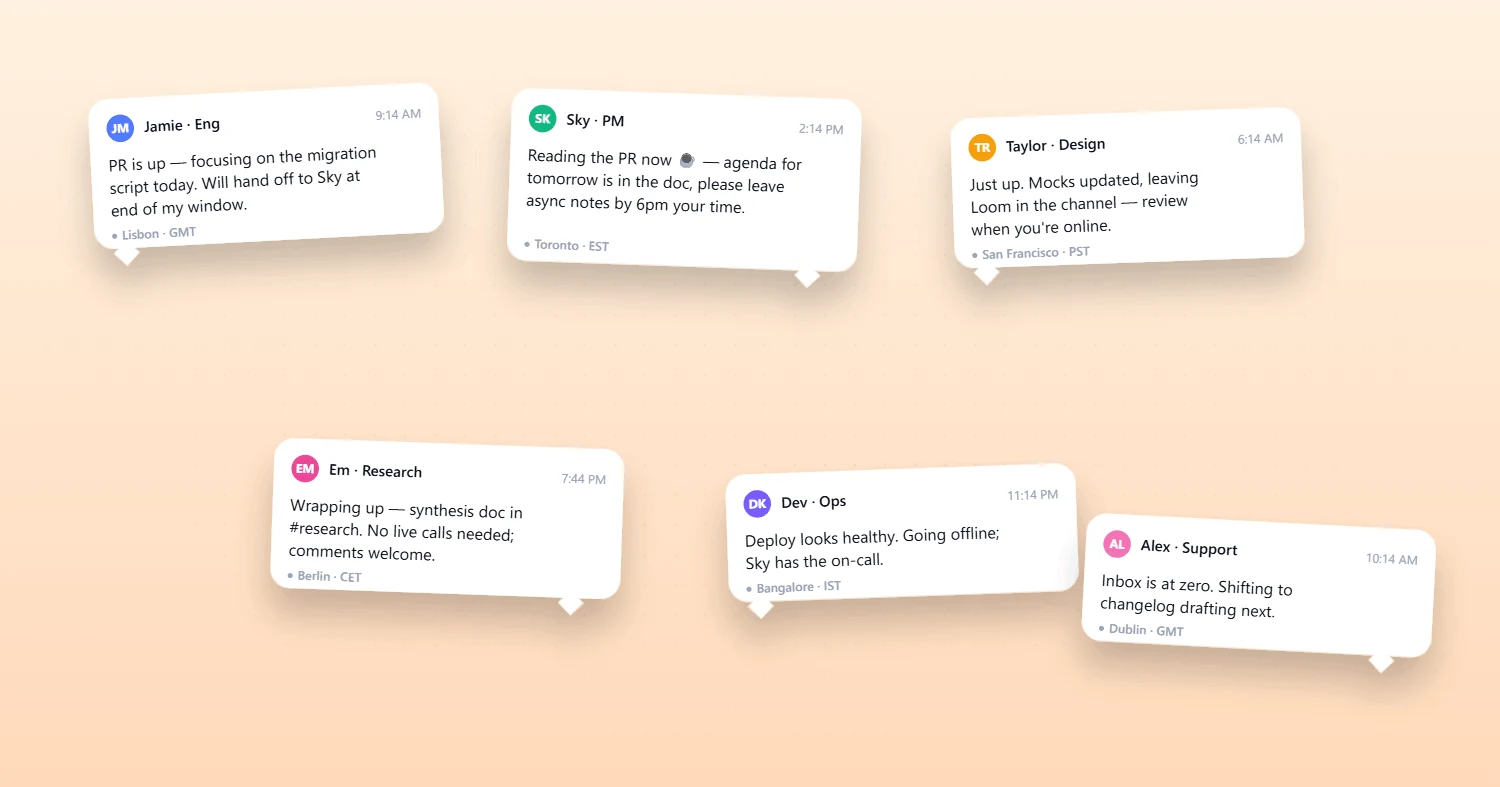
Async status updates allow team members to contribute when it suits them, reducing the need for constant real-time check-ins.

Flexibility is a key benefit of asynchronous communication, supporting productivity across time zones.

This flexibility is especially powerful for global teams working across multiple time zones.

Short Sync Only for Complex Decisions

Short, focused synchronous meetings are best reserved for complex or urgent decisions that require real-time input.

This approach helps teams maintain focus and avoid unnecessary interruptions. For blended workflows, consider an all in one task management and communication platform.

This approach preserves team energy and ensures real-time meetings are reserved for high-stakes, meaningful exchanges.

Where Fluorine Fits

All the best practices outlined above are built into Fluorine’s all in one task management and communication platform, designed for distributed and hybrid teams. Fluorine centralizes chat, tasks, feedback, and analytics, giving teams a single workspace to keep everything visible and actionable.

Here’s how Fluorine stands out:

  • Unified Task Management & Communication: No more switching between tools; all work and conversations live in one workspace.
  • Integrated Feedback & Reporting: Built-in surveys and analytics help teams improve continuously.
  • Smart Search & Real-Time Updates: Instantly find tasks, files, or messages, and stay current with real-time notifications.
  • Mobile Access: Keep your team connected and informed wherever they are.
  • Continuous Feedback Loop: Fluorine’s built-in survey and analytics tools help teams adapt and grow from real-time feedback.

Fluorine is trusted by over 1,200 teams, with a 94% customer satisfaction rate and a proven 28% boost in team productivity.

Explore core task and collaboration features or start with the setup and usage guide.

Setting Up for Success: Resources and Next Steps

Continuous improvement is the hallmark of high-performing distributed and hybrid teams. Tap into proven resources, training, and support to keep evolving your communication practices.

Start by visiting our help center—and use the support resources to set up channels, notifications, and team norms that keep your team aligned and empowered.

As your team grows, leverage routine feedback and adapt your communication practices to stay aligned.

References

Boost Your Team’s Productivity with All-in-One Task Management & Communication

Start using Fluorine and experience effortless collaboration. Our tools are designed to fit your team’s workflow, no matter the size.